Estimation settings record how an estimate is constructed: the estimation method and coefficient selection, reference projects, project types, comparison-parameter limits and graph options. Saving them makes the basis for an estimate easier to retrieve and review later.
Save and open settings
In the Estimation window, choose Setting > Save Current Setting to retain the current setup for the selected estimate. Choose Setting > Edit Settings to open the Estimation Settings window. Settings are associated with a weight group and a value type, and can also belong to an individual item when item estimation is used.

The Estimation Settings window edits the saved setup. It does not itself calculate a new weight or centre of gravity, and it is separate from the named Setting and Save Estimate functions in Auto Estimation. After changing a setup, return to the appropriate estimation window to review the calculation.
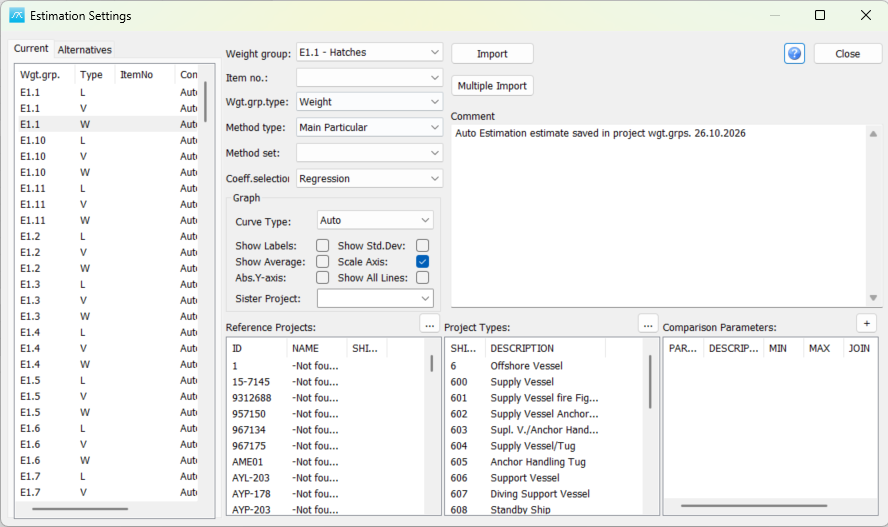
Select the setting to edit
The list on the left identifies saved settings by Wgt.grp., Type, ItemNo and Comment. Select the relevant entry and check the Weight group, Wgt.grp.type and, where applicable, Item no. fields before editing. Weight, VCG and LCG settings can have different methods and reference selections even for the same group.
When you change Weight group or Wgt.grp.type with pending edits, the program can ask whether to save the previous setting. Complete and save the intended edits before moving to another setting.
Method and coefficient selection
Method type selects the estimation-method family. Method set identifies the configured set of definitions, including additional sets available in the system. The labels of the standard method families can be configured, so use the names shown in your installation.
Coeff.selection chooses the basis for the method coefficient: Subjective, Regression, Default, Sister Project, Adjusted Sister Project or Average. Select a Sister Project when the chosen coefficient basis requires one. Choosing a coefficient source does not create missing reference data or define a suitable method by itself.
Use Comment to record why the method, reference projects or coefficient basis were chosen. This gives later reviewers context that cannot be inferred from the resulting number alone.
Graph options
Curve Type controls the regression-curve selection: Auto, Linear, Logarithmic, Power, Exponential, Inverse or Polynomial. Auto delegates curve selection to the estimation calculation; the other choices request a particular curve type.
Show Labels displays project IDs in the graph. Show Std.Dev and Show Average control the standard-deviation and average lines. Scale Axis, Abs.Y-axis and Show All Lines control axis presentation and the regression lines displayed. These settings affect the estimation graph and should be reviewed together with the plotted reference data.
Reference projects and project types
The Reference Projects list contains the projects included for the selected estimate. Use its ... button to change that selection in Reference Projects. The Project Types list contains the allowed types; use its ... button to select them. Both selections affect the historical data available to the estimate.
These selections belong to the specific weight-group/value-type setting. They may differ from the general reference choices made when starting an estimate. Check them when an expected historical project is absent from the estimation plot.
Comparison parameters
The Comparison Parameters list shows parameter IDs and descriptions together with MIN, MAX, JOIN and FILTER values. These describe the comparison limits and filtering saved for the estimate; they are not new values for the current project parameters.
Double-click a comparison-parameter row to inspect its join limits for a numeric parameter. The operation also toggles its JOIN flag, so check the resulting row before leaving it. The + button rebuilds the comparison-parameter list from the method and asks before deleting existing entries; using it can clear customised limits or filters.
Import settings
Import opens the setting-import dialog for a single source setting. Select the source project and setting, then review the imported method, graph options, references, project types and comparison parameters before saving them for the intended target.
Multiple Import transfers several settings using the import dialog. Review the source and target scope carefully because several existing settings can be affected. Importing estimation settings transfers the calculation setup, not the source project's complete item list or weight values. The related import topic below describes the import workflow.
Apply changes to several settings
The right-click menu in the saved-setting list provides Select All and Deselect All, along with commands for setting or removing a sister project and setting coefficient selection for the highlighted entries. A highlighted entry is a target for these commands; it is different from selecting reference projects inside an individual setting.
These bulk commands write to the selected saved settings directly. Finish pending edits to an individual setting before a bulk change, and review the affected settings afterwards.
Close and save
Close saves pending edits to the displayed setting and closes the window. Database changes already made by bulk commands, multiple import or separately accepted dialogs are not a preview waiting for Close, and closing or cancelling this window does not undo those completed operations.
Press F1 or click the Help button beside Close to open this topic.
Related information